Fostering understanding, respect, and collaboration in our community for its First Peoples
A Timeline of Colonisation & Reconciliation
Key historical events with impacts, or leading to impacts, on the Wurundjeri Woiwurrung and the Nillumbik area.
Since time immemorial
First Peoples of Nillumbik
Melbourne and it’s north-east are inhabited by a clan of the Woiwurrung-speaking people now known as the Wurundjeri-willam of the Kulin nation.
“The Wurundjeri People take their name from the Woiwurrung language word ‘wurun’ meaning the Manna Gum (Eucalyptus viminalis) which is common along ‘Birrarung’ (Yarra River), and ‘djeri‘, the grub which is found in or near the tree. Wurundjeri are the ‘Witchetty Grub People’ and our Ancestors have lived on this land for millennia.”
Source: Aunty Joy Murphy Wandin AO
The Wurundjeri people know their land intimately and move through it with the seasons. They live lightly from the land, husbanding its resources. In the summer they camp along the banks of Birrarung and its tributaries, then move inland to the hills and ranges as the days shorten.
1500s
Mercantilist doctrine fuels global colonialism
Far, far away, European powers Spain and Portugal settle among and establish political control over large parts of Central and South America. France and England do the same in Northern America and the Lesser Antilles.
This era of colonialism establishes mercantilism as the leading school of economic thought, where the economic system is viewed as a zero-sum game in which any gain by one party requires a loss by another.
The mercantilist doctrine encourages many intra-European wars of the period and arguably fuels European expansion and imperialism throughout the world lasting as long as the early 20th century.
c. 1571 CE
Yingabeal
Not far from a river bend in the Birrarung, at present-day Heidelberg, a River Red Gum seed germinates just below the surface. Within 6 months it is a small sapling about 50cm tall. This tree will grow to become the present-day Yingabeal.
July 1588
The Rise of English Power
The Spanish Armada attempts to invade England but is famously defeated. This marks a turning point in naval dominance and heralds the rise of England as a global superpower.
26 February 1606
Willem Janszoon and his crew of the Duyfken made history in 1606 by being the first recorded Europeans to set foot on Australian soil at the Pennefather River (north of modern day Weipa) on Cape York Peninsula
Source: ‘Mapoon’ Wik-Mungkan people, edited by Janine Roberts.
Pre-colonisation
The Aboriginal population of Victoria before the introduction of European diseases in the late 18th century is estimated to be more than 11,500 people.
Source: National Museum of Australia / A. R. Radcliffe-Brown
April 19, 1770
British landfall at Botany Bay
Lieutenant James Cook, aboard the HMS Endeavour, makes landfall on the eastern coast of Australia at Botany Bay (modern-day Sydney). This marks the first direct contact between the British and the First Nations peoples of Australia.
On August 22 — reflecting the European legal doctrine that land could be claimed if it was deemed “uninhabited” or not being utilised in a manner recognised by European agricultural standards — Cook claims the eastern coast of Australia for Britain, naming it New South Wales. This act of claiming sovereignty over the land without the consent of the Indigenous inhabitants sets the stage for British colonisation.
January 18, 1788
The First Fleet Arrives
The First Fleet arrives at Botany Bay. Finding it unsuitable for settlement, Captain Arthur Phillip, decides to move to Port Jackson, where a week later they establish the first permanent European colony in Australia. This date is now commemorated as Australia Day, but it marks a day of mourning and reflection for many First Nations people, known as Invasion Day or Survival Day.
The establishment of the colony at Sydney Cove begins the systematic dispossession of Indigenous lands, disruption of traditional lifestyles, and the onset of conflict and disease that will decimate First Nations communities throughout the following centuries.
April 1789
Smallpox Epidemic
In the early days of Sydney’s settlement, a severe smallpox epidemic breaks out, likely introduced by the ‘variolas matter’ brought on the First Fleet by Surgeon John White for inoculation purposes in the new colony.
While the Europeans have some immunity from prior exposure, Indigenous Australians have no such resistance. The disease spreads rapidly, causing high fever, a severe rash, and often fatal outcomes within just one or two days.
A huge number of Aboriginal people succumb to the virus, devastating communities across the continent. It is estimated that before colonists even reach the Port Phillip district, smallpox has already decimated a third of the eastern Australian Indigenous population.
In Sydney, Captain Thomas Melvill of the whaling ship Britannia is presented with a silver cup by Governor Arthur Phillip for killing a Sperm Whale, it “being the first of its kind taken on this coast since the Colony was established.”
Source: DL MSQ36, State Library of NSW
15 March 1797
Survivors from the Sydney Cove shipwreck are shipwrecked a second time near Lakes Entrance. Seventeen sailors, including Europeans and Bengali crew, trek 700 km along Australia’s southeast coast, being among the first Europeans to encounter Indigenous groups like the Kurnai and Thaua, who aid them despite cultural misunderstandings. Only three survived the journey, reaching Sydney after two months, marking a cross-cultural survival milestone.
Source: ‘Australia’s Lost Histories’ Dr Mark McKenna / University of Sydney
1790s
Rumours of an Alien Race
Far to the south, rumours of an alien race rising up from the sea begin circulating among the Wurundjeri, who wonder who they are and where they’ve come from.
Bunurong people at a Kulin gathering, possibly at Bolin Bolin, change rumour into fact as they report their wives and daughters being kidnapped by sealers and whalers working the Bass Strait and adjoining coasts.
15 February 1802
First Europeans in Port Philip
John Murray in the Lady Nelson enters Port Phillip, followed shortly after by Matthew Flinders.
The arrival of Europeans in Victoria irrevocably changes the lives of the many Aboriginal groups inhabiting the area. Initial conciliation gives way to European arrogance and Aboriginal resentment stemming from the settlers’ exclusive idea of property.
Jan—Feb 1803
First Europeans navigate the Birrarung
Charles Grimes, deputy surveyor-general of New South Wales is sent by Governor Phillip King to Port Phillip to survey the area. They enter Port Phillip on January 20.
By February 8, Grimes reaches Dights Falls. Another member of the party, James Fleming, notes in his diary about finding good soil and suggests along the Yarra is the most eligible place for a settlement.
8 October 1803
First Attempted Settlement in Port Phillip
The British governor of New South Wales, fearful that the French might try to occupy the Bass Strait area, sends Colonel David Collins with a party of 300 convicts to establish a settlement.
Collins arrives at Sorrento but is put off by the lack of fresh water, and abandons the area by the end of the following January. Among the convicts is John Pascoe Fawkner who will later come back to settle in the Melbourne area.
1824
Simon Wonga is Born
Simon Wonga, son of Billibellary (c.1799-1846), is born near Arthur’s Seat (“Wonga” being the Aboriginal place name for this area). Wonga goes on to became Ngurungaeta (leader) of the Woi wurrung clans in 1846, at the age of 22, following the death of his father. In 1863, Wonga and his cousin William Barak lead their remaining people across the Black’s Spur Songline to the Upper Yarra and established Coranderrk. The Melbourne suburb of Wonga Park and Wonga Road are later named after him.
1824
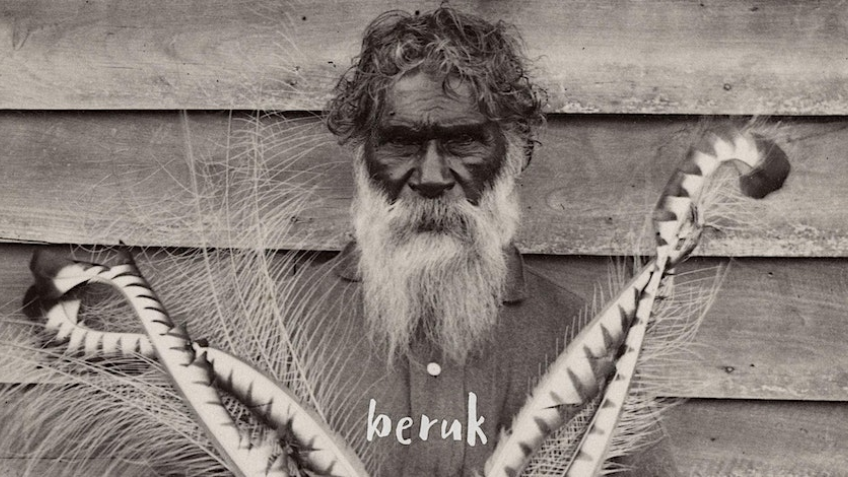
William Barak is Born
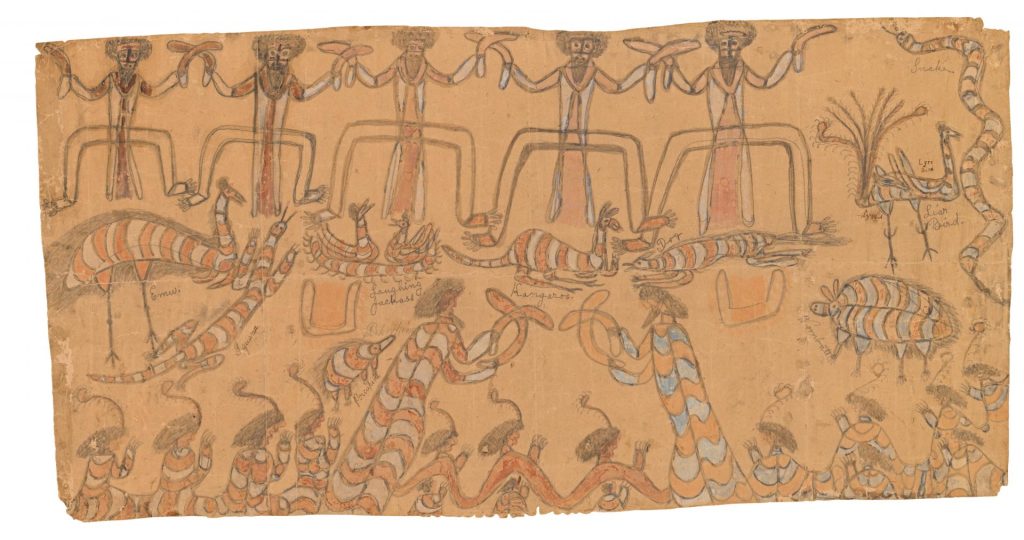
Beruk, son of ngurungaeta Bebejan and his wife Tooterrie, and cousin of Simon Wonga, is born downstream from Wyenondabul, at Brushy Creek in Wonga Park. He will be the last traditional ngurungaeta of the Wurundjeri-willam clan, and become an influential spokesman for Aboriginal social justice and an important source of Wurundjeri cultural art and lore.
7 December 1824
Europeans Arrive from the North
Hamilton Hume and William Hovell, looking for new grazing land in the south of the colony, come overland from New South Wales and, due to thick vegetation and injuries, are thwarted in their attempts to reach the summit of Mt Disappointment to view the coast. Instead of crossing the Great Diving Range they shift their direction to the west via Mount Macedon, later mistaking Corio Bay for Western Port due to errors in navigation.
1824
A smallpox epidemic hits the Wurundjeri, who initially see it as Bunjil’s Myndie serpent punishing lore-breakers.
28 August 1833
Slavery is outlawed in the British Empire, including Australia, by the Slavery Abolition Act, following an anti-slavery movement that began in 1783. There is a growing ‘mood of philanthropy’ in England, which is, however, a long way from Port Phillip where a war over land is underway.
29 May 1835
John Batman Explores
John Batman, enterprising farmer and murderous participant in Tasmania’s “Black Wars” (1803-1830), during his first foray into the Port Phillip district near Geelong, notes “…as rich land as I ever saw with scarce a tree upon it, the grass above our ankles…Most of the high hills were covered with grass to the summit, and not a tree… The whole appeared like land laid out in farms for some hundred years back, and every tree transplanted. I was never so astonished in my life”
Batman’s description reflects a common European perception of the Australian landscape as being naturally ready for farming and settlement, which often ignored the Indigenous land management practices that maintained these environments.
6 June 1835
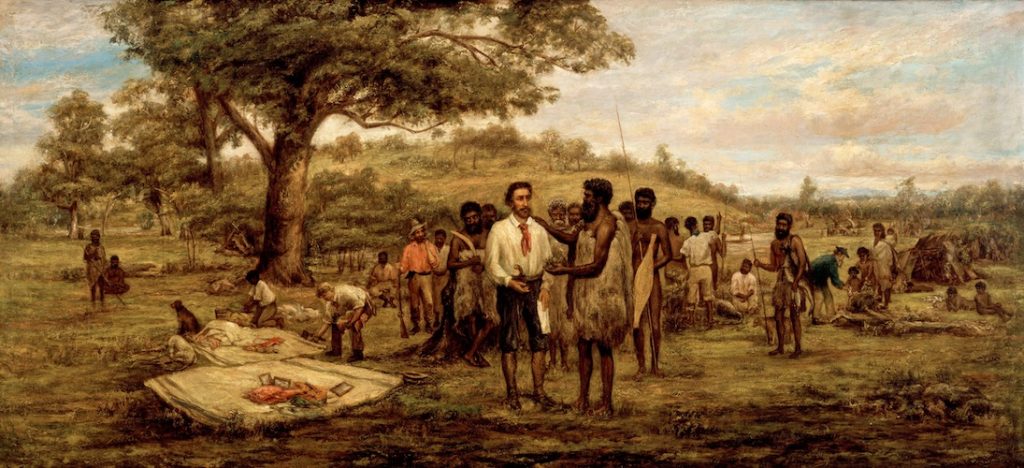
The Batman ‘Treaty’
Headman Bebejern, along with Billibellari and Jagga-Jagga are the three main signatories to John Batman’s purported deed of sale for full possession of more than 240,000 hectares of the Kulin people’s ancestral lands.
In return, Batman offered the Wurundjeri token items including blankets, flours, knives, tomahawks, scissors, mirrors, shirts and beads. It is now believed that the Wurundjeri may have thought Batman was offering them gifts in exchange for safe passage – a transaction known as tandarrum.
This meeting occurred probably at either Merri Creek near present Rushall station or on the Plenty River at present day Greensborough.
Batman writes in his diary “this will be the place for a village” and leaves a party to continue surveying while he returns to Van Diemen’s Land in the Rebecca.
Source: Diaries of John Batman 1830-1835, National Library of Australia
June 1835
Sexual violence
The newly formed Port Phillip Association, apparently honouring their ‘treaty’, is making unsuccessful attempts to return Aboriginal women abducted from the Victorian coastline by sealers and whalers. Rapes are common in the frontier town. Aboriginal camps on the outskirts are seen as a place of entertainment, drunkenness, gunfire, violence and interracial sex.
Source: Edmonds, Urbanizing Frontiers
4 August 1835
Fawkner’s ship the Enterprize sails from Launceston with a party of intending settlers. Finding the area near present-day Williamstown unfavourable, they move up river close to the current site of Melbourne. This marks the beginning of a permanent European settlement in the area. Fawkner soon returns to Launceston due to illness.
26 August 1835
The New South Wales government annuls Batman’s treaty with an act of Parliament, confirmed by the British Colonial Office in Whitehall on 10 October 1835. If the Aboriginal inhabitants had the right to dispose of their land, the Crown’s claim would be in doubt.
Annulment of Batman Treaty
Source: Proclamation of Governor Bourke 10 October 1835, National Archives of UK
2 September 1835
Batman returns
Batman arrives at Melbourne and is dismayed and angry to find Fawkner’s people already in possession. Tensions rise over the rightful claim to the land and who should have leadership over the settlement.
16 October 1835
Fawkner returns
Fawkner arrives with another party of settlers and Batman and Fawkner agree there is plenty enough land for everyone.
1836
The Aboriginal population of the immediate Melbourne area is estimated to be 700 people.
Source: Edmonds, Urbanizing Frontiers
1836
Billibelleri Becomes Ngurungaeta
Bebejern dies and Billibelleri (of north of the Yarra) becomes headman and seeks to establish an Aboriginal Reserve at Bolin-Bolin in Bulleen, then at Pound Bend in Warrandyte. He later builds a close and mutually beneficial relationship with William Thomas, Assistant Protector of Aboriginals.
20 February 1837
Social reformers in Britain, stated to be alarmed at the devastation of Indigenous populations throughout the empire, prompt an investigation by the Parliamentary Select Committee on Aboriginal Tribes (British Settlements).
The resulting ‘Buxton Report’ of 1837, recommended the enactment of special laws to protect Indigenous people.
1837
Henry Arthur, nephew of the lieutenant governor of Van Diemen’s Land, establishes a station in present-day Diamond Creek, part of which extends to Kangaroo Ground.
The Ryrie brothers, who travelled overland from Monaro with vine cuttings and 250 head of stock, take 58,000 acres of prime hunting country, almost the entire Yarra Valley, and build a dwelling at Yering.
1837
A mission and school is set up on south side of the Yarra at a meeting place and corroboree site (at the present-day botanical gardens). The mission and school fail because Kulin people refuse to give up their cultural practices.
1837
Captain Alexander Maconochie proposes a Native Police force as an alternative to protection, based on ideas of assimilation and compensation for land. A force is established on three different occasions – 1837, 1839 and 1842.
1838
Aboriginal people are pushed further and further out of the settlement at Port Phillip, and freedom of movement becomes increasingly difficult due to fences and guns. Settlers hunt wildlife at an unprecedented level for sport and food. Introduced sheep and cattle trample and kill vegetation.
1838
In response to the 1837 Buxton Report, the English Secretary of State for War and the Colonies recommends a protectorate be established. It is required to learn the Aboriginal language. The stated duties are to watch over the rights of Aborigines, guard against encroachment on their property and to protect them from acts of cruelty, oppression and injustice. The Port Phillip Aboriginal Protectorate is formed with George Augustus Robinson as chief protector and four full-time protectors sent from England. Robinson is later best remembered for his journals, his abandonment of Tasmanian Aboriginals at Wybalenna, the forwarding of Aboriginal objects including human skulls to British museums, and his association with events that eventually led to the hanging executions of Maulboyheenner and Tunnerminnerwait.
3 January 1839
The four Assistant Protectors, Edward Stone Parker, James Dredge, Charles Wightman Sievwright and William Thomas arrive in Melbourne from England via Sydney, all with wives and with 22 children between them.
12 February 1839
An elder Bonurong woman named Dindo and her two sons Derremot and Ningerranow with their families were the first people to come in to the Assistant Protectors presenting with the symptoms of influenza, which was to sweep through the Aboriginal population.
From 1839
The audacious and illusive Jaga-Jaga (brother of Billibellary) and the younger Winberrie, along with a band of other supporters fight a resistance war against local settlers of the Yarra Valley and wider Victoria, burning their paddocks and driving off their stock.
1839
Government surveyor T. R. Nutt does a full survey including the Templestowe-Warrandyte area describing it as ‘Grassy hills, thickly timbered stringy bark forests and gums’ assuming it is a virgin landscape rather than a carefully managed environment.
September 1839
Charles La Trobe
Charles Joseph La Trobe arrives in Melbourne as the first Superintendent of Port Phillip District. With him are his wife and daughter, two servants and a prefabricated house. La Trobe is a particularly evangelical and religious person for his time, also involved in anti-slavery circles. Over the following 16 years he establishes key Melbourne civic features, and as the chief government official nonetheless plays an integral role in the dispossession of Aboriginal peoples from their lands.
13 January 1840
Battle of Yering
An armed conflict, later known as the Battle of Yering, takes place on William Ryrie’s Yering Station in the Yarra Valley.
The conflict involves fifty Wurundjeri clansmen clashing with troopers led by Captain Henry Gisborne, who has been sent to capture their leader, Jaga Jaga.
After an exchange of gunfire forces the Wurundjeri to retreat to the Yarra Flats Billabongs beside present-day Yarra Glen, they manage to draw the troopers away and rescue Jaga Jaga, with no injuries reported among the troopers or settlers.
April 1840
La Trobe tells Assistant Protector of the Aborigines William Thomas that unless he succeeds in breaking up the Melbourne encampment, he will send Captain Russell of the Mounted Police to do so by force.
Source: Anderson, ‘La Trobe and the Kulin’, Agora 57
September 1840
Lieutenant Governor La Trobe issues orders banning Aboriginal people from Melbourne.
October 1840
The Lettsom Raid
During apprehension of several Taungurung men, who are attending an initiation on Kulin land, Major Samuel Lettsom and fifty red-coat troopers ride to an encampment on Heidelberg Road and arrest all but a few who escape. More than 200 Woiwurrung, Boonwurrung, and Taungurung people are rounded up by “pricking them with bayonets and beating them with the butt end of muskets” and forcibly detained in sheds near the Birrarung, allegedly in response to frontier violence.
Tragically, during the raid a 20 year-old Wurundjeri Woi Wurrung man named Winberri, who fought alongside Jaga Jaga and is renowned for his confidence, intelligence, respect and noble spirit, is shot dead while questioning Lettsom’s intent. His death prompts an unusual and profound mourning ritual performed by his father and sister, and is documented by William Thomas.
The Lettsom Raid epitomises the colonial intent to exclude Indigenous people from Melbourne, reinforcing the oppressive policies of the time. It is later criticised as part of broader coercive measures to control and marginalise Aboriginal people.
Source: Journal of William Thomas
1840
William Thomas establishes a station at Narre Narre Warren as part of a new Aboriginal Protectorate (including Native Police) to replace the failed school and mission. He is not successful at convincing the Woi wurrung and Boon wurrung so far from Melbourne and by 1843 had moved to the Merri/Yarra confluence, and established the Merri Creek School for Aboriginal children with some success.
1840
Eleven of the twenty-six people recorded as being in custody in the Port Philip District are Aboriginal, an over-representation that appears to presage present day criminal justice statistics.
1840s
A gathering of 600-700 Kulin people draws attention of colonists who don’t like the camps being so close to town, and the Kulin mia mias are burned down. Beatings and horse-whippings regularly occur on the streets of Melbourne, often in response to what is perceived as begging.
1841
The European population of Melbourne is 11,738 people.
Source: Catholic Encyclopedia, Melbourne (1913)
1841
James and Isabella Donaldson and their 5 children, fresh ashore from Scotland, buy 1 square mile of land in Kangaroo Ground. They immediately come under attack from roving bushrangers who steal their silver and take a horse. Also aware of Jaga Jaga, the Donaldson’s invite six tenant farmers to join them, almost all also Scottish.
Source: Wilkinson
1841
Colonist and grazier Cornelius Sharpe Haley takes land at Upper Diamond Creek and calls it the Caledonia run. He erects a timber slab homestead ‘Allwood’ as part of lease conditions. At the 1841 census it shows a manager, stockman and gardener are employed there.
1842
Tunnerminnerwait and Maulboyheenner, male Aboriginal survivors of the notorious ‘Black Wars’ in Van Diemen’s Land, are the first people to be hanged by the Government in the District of Port Phillip. They were convicted of the murder of two whale-hunters at Cape Paterson, twenty miles south of the Western Port area. after absconding and ‘commencing a course of crime’ following their witnessing of frontier violence while working for George Augustus Robinson. For months the public had followed the case, and the hangings were attended by six thousand spectators. The executions were a cruel and mismanaged debacle.
1842
Victoria is occupied by over 12,000 settlers, as well as about 100,000 cattle and 1.5 million sheep.
1843
Ngurungaeta Billibellary requests land to be reserved for the Woiwurrung clans. His request is not granted.
10 August 1846
Billibellary had developed a serious chest infection and the inflammation killed him. He was buried at the confluence of the Merri and Yarra. A picket fence was placed around his grave jointly by Thomas and Wurrundjeri, but this was later washed away and the site is now unknown. He is succeeded in leadership of the Kulin by his son Simon Wonga, who sought work opportunities for his people with local settlers to learn white agricultural and stock management skills.
June 1847
An epidemic of influenza hits the large Wurundjeri encampment at the confluence of the Yarra River and Merri Creek particularly hard. Those who survived the initial impact of disease had to live with the grief and devastation within their community, and this discourages Aboriginal people from returning to former campsites such as this.
Dec 1849
The Aboriginal Protectorate is dismantled because of lack of support by the government or the public.
January 1850
William Thomas is named Guardian of the Aborigines and given almost identical instructions, except for the emphasis by La Trobe to ‘keep the blacks out of Melbourne’.
Feb 1851
Black Thursday bushfires are widespread: 15 dead, 5 million hectares burned.
1851
Kangaroo Ground is the only thriving farming community in the Yarra Valley upstream of Heidelberg.
June 1851
A party finds gold in the quartz rocks of Andersons Creek, near Warrandyte.
July 1851
The Victorian Gold Rush
Successful agitation by the Port Phillip settlers leads to the establishment of Victoria as a separate colony, and La Trobe as its first Lieutenant Governor.
Shortly before and immediately after separation, gold is discovered at several locations (after the government stops keeping the presence of gold in the colonies secret in fear of disorganising the young colony). By 20 July, the Mount Alexander / Forest Creek Diggings (at present-day Castlemaine) are the richest shallow alluvial goldfield in the world. They are soon surpassed by Bendigo and Ballarat, Beechworth, Bright, Omeo, Chiltern and Walhalla. The ensuing gold rush radically transforms Victoria and Melbourne.
1851
Population of the whole Port Phillip district is 77,000, with only 23,000 in Melbourne.
March 1852
Simon Wonga organises the last great intertribal corroboree of the Kulin and other nations at Pound Bend in Warrandyte. His purpose was to allow his people to draw the curtain on their traditional life and find a way to survive in the new world that had been thrust upon them. For 14 days and nights the Kulin people held a celebration of traditional culture, including music, ceremony and traditional games such as marngrook.
Following the discovery of gold, Melbourne’s population doubles in a year. 75,000 people arrived in the colony, mainly by sea. Combined with a very high birth rate, this leads to rapid population growth. Concurrent dispossession of Aboriginal populations in inland Victoria is equally rapid.
1853
Work is begun on Yan Yean Reservoir to provide water for the growing Melbourne.
1850s
Alcoholism is endemic across the Victorian Aboriginal population
1854
A gold rush to the Caledonia diggings commenced in Upper Diamond Creek and Back Creek, taking over sections of Haley’s Caledonia run leasehold.
1850s
The Yarra River has become quite polluted and is the cause of an epidemic of typhoid fever. Fellmongery and woolwashing, tanneries (500 sheepskins and 200 cattle hides per week), sewerage and garbage dumping were the cause, particularly around Collingwood, Abbotsford and Richmond. It caused a stench for miles around. By the late 1850s nightmen were employed to deal with sewerage, but many simply dumped it in the Yarra.
1857
William Thomas, age 64, stops living with the Wurundjeri and Boonwurrung people. He continues as Advisor on Aboriginal Affairs until his death on 1 December 1867.
1858
A ‘select committee of the Legislative Council on the Aborigines’ is formed by the Victorian government and the following year publishes a report recommending the establishment of government reserves, including ‘more vigorous compelling’ to move, at Ebenezer, Lake Tyers, Framlingham, Lake Condah, Ramahyuck, Coranderk and Yelta.
1860
The Victorian Nicholson Land Act is the first of several Acts that allow settlers to acquire crown land of 80-640 acres for intensive farming, with the intent of encouraging closer settlement. Settlers paid half the purchase price upfront and leased the rest, completing payment and improvements within seven years to gain ownership. The policy aimed to promote agriculture like wheat-growing over wool production but often led to disputes with squatters who already occupied the land and found ways to bypass the laws.
March 1863
Less than 30 years after the founding of Melbourne frontier violence and the introduction of European diseases have decimated the population and only about 2,000 Victorian Aboriginal people survive. Europeans believe Aboriginal people are a dying race.
Early 1863
Black Spur
Simon Wonga and William Barak lead around thirty Kulin people through the Yarra Ranges, following a traditional songline route known today as the famous Black Spur road. They settle at a traditional camping spot on Badger Creek near present-day Healesville.
In a politically savvy move, Simon Wonga forms a deputation to travel to Melbourne and appeal to the Governor of Victoria, Henry Barkly, for ownership of the chosen site near Badger Creek. The group comes bearing gifts, including hand-woven baskets and traditional weapons and Simon delivers a heartfelt address in Woi wurrung.
After a number of false starts, 2,350 acres at the site near the confluence of the Yarra River and Badger Creek are gazetted as a reserve (not as freehold) for Coranderrk Aboriginal Station, named after the flowering plant. Indigenous testimony shows that Coranderrk was productive and profitable in its early years.
Mssr Peers, Haley and Wilson discover gold in he Diamond Creek. Diamond creek mine was opened several years later.
Diamond Reef discovered by Thomas Wright Soady on Dr John Blakemore Phipps property (stretching from Reynold’s Rd to the Diamond Creek)
1864
Sarah Ellen Hurst wrote to a friend in England that ‘We have a great many cattle, horses and sheep. Sheep pay a deal better than cattle or horses. If we had sheep when first we came we should now have been independent. … We have a great deal of fruit. We give a great deal to the pigs. Our peach trees are as large as the apple trees at home. … We are still living with bush all around. We have no neighbours, we are twenty miles from Melbourne.’
6 August 1864
There are 70 Aboriginal people living at Coranderrk.
The Age No. 3 050 p.7 via National Library of Australia
1874
Simon Wonga dies and is succeeded as headman by William Barak.
17 August 1880
Melbourne’s civic pride is demonstrated by the huge edifice of the Royal Exhibition Building, built for the Melbourne International Exhibition.
Foundation stone of St Pauls Cathdral is laid the same year.
The population of Melbourne is 280,000.
1881
Inquiry into Conditions at Coranderrk Aboriginal Station
1880s
The long boom culminates in a frenzy of speculation and rapid inflation of land prices known as the Land Boom. Governments shared in the wealth and plowed money into urban infrastructure and railways. Victorian businesses and politics become notorious for corruption.
1886
The Victorian Government adopts the ‘Half Caste Act’ requiring that Aboriginal people with European ancestry aged between 15 and 35 leave reserves such as Coranderrk to undertake employment and ‘absorption’ into the general white community. By 1893 this had reduced the population at Coranderrk to 31 people.
1889
The population of Melbourne reaches 445,000. For a time it is the second largest city in the British Empire, after London. It is already one of the largest cities in the world in terms of area because of the quarter-acre dream and suburban sprawl.
1889
Cooper v Stuart
The Privy Council (the highest court of appeal for the British Empire, of which Australia was a colony at the time) ruled that New South Wales was considered “practically unoccupied” at the time of British settlement, justifying the application of British common law. Although the case itself was unrelated to Aboriginal land rights, this decision reinforced the concept of terra nullius, denying the recognition of pre-existing Indigenous land rights in Australia until it was later challenged by the Mabo decision.
1891
The inevitable economic bust – a spectacular crash that ends the boom. Banks and other businesses fail in large numbers. Thousnads of shareholders lose money. Tens of thousands of workers are put out of work. Possibly around 20% unemployment inMelbourne throughout the 1890s.
Melbourne’s population scarcely changes from 490,000 for the next 15 years as a result of the crash. Immigration dries up, emigration to goldfields in WA and South Africa increases, and the high birthrate falls sharply. Urban poverty becomes a feature of city life and the slums spread.
1890s
Coranderrk is reduced in size as pressure from settlers causes government to sell or lease portions.
1903
William Barak dies.
1 Dec 1905
Widespread bushfires (incl. Dandenong Ranges). 12 dead. 24,281 ha burned.
25 June 1912
Despite inclement weather, up to 500 people attended the opening of the Eltham-Hurstbridge railway on 25 June 1912. Local member of parliament Ewen Cameron and Victorian Premier William Watt were present.
By 1914, 1,886 acres of orchards were under cultivation, with a considerable proprotion of the fruit being exported overseas.
1920
Board sells/leases land to Colin MacKenzie for a fauna research centre (now Healesville Sanctuary).
1923
The hated Aboriginal Protection Board forces Coranderrk residents into exile at Lake Tyers. All but six are moved: Only Lankie and Annie Manton, Alfred Davis and his wife, Mrs Dunnolly and Bill Russell were permitted to remain at Coranderrk.
The Wall Street Crash ushers in another Depression which lasts until a brief return to prosperity in late 1930s, cut short by outbreak of World War II
1930
Melbourne’s population reaches 1 million.
1934
Melbourne celebrates its centenary and acquires the landmark Shrine of Remembrance.
1934
Land where the Heide tree stands (7 Templestowe Rd, Bulleen) is bought by John & Sunday Reed, who opened their home to like-minded artists like Sidney Nolan, Albert Tucker and Joy Hester.
26 January 1938
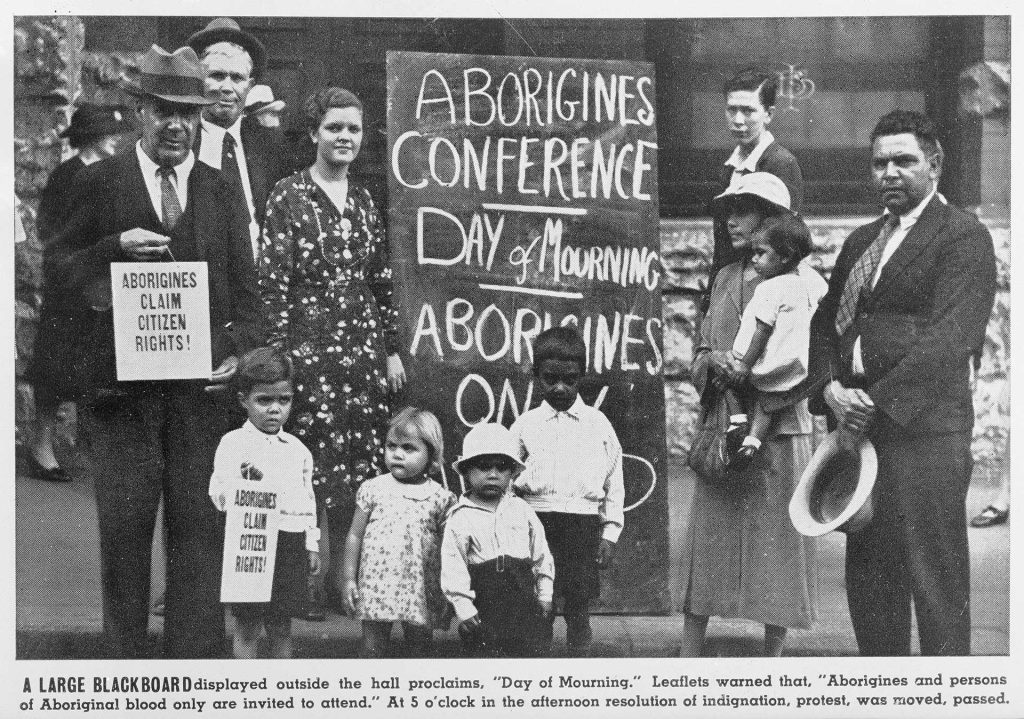
Day of Mourning
While many Australians celebrated the one hundred and fiftieth anniversary of the landing of the First Fleet, a group of Aboriginal men and women gathered at Australia Hall in Sydney, a culmination of years of work by the Australian Aborigines League (AAL) and the Aborigines Progressive Association (APA). The assembly would became the inspiration for Aboriginal and Torres Strait Islander activism throughout the remainder of the twentieth century. In the early 1960s, both organisations would reform and reshape and become the driving force calling for a constitutional referendum that would take place in 1967.
13 January 1939
Black Friday bushfires across southern Victoria. 71 dead. 2 million ha burned.
1940
There is active debate in Australia over the origins of the continents first human inhabitants. It is often argued that Australia had been settled by successive waves of culturally and biologically distinct people. The earliest of these waves was said to be represented by Tasmanian Aborigines, with mainland Aborigines being a mixture of different groups of immigrants, claiming to be reflected in the varying appearance of modern-day populations.
October 1940
The Keilor cranium is unearthed while excavating a sand deposit. It is among the first archaeological sites to demonstrate the antiquity of Aboriginal occupation of Australia, pushing the date of Aboriginal occupation back from 2000 years to 15,000 years (1971 radio carbon dating dated it to 31,000 years).
1948
Coranderrk Lands Bill revoked the reservation of Coranderrk’s remaining land which was then divided up for solider settlement. No Aboriginal soldiers were eligible for the land.
December 1956
Warburton Ranges Controversy
In December 1956, a Western Australian parliamentary report exposed the severe hardships faced by the Wongi people, including malnutrition, disease, and high infant mortality rates. Initially ignored, the report gained significant attention after the Sydney Tribune highlighted it, sparking national outrage and calls for urgent action. Mainstream media echoed these concerns, demanding immediate investigations and better treatment for the Aboriginal people. However, subsequent visits by journalists and anthropologists, including Rupert Murdoch and Ronald Berndt, produced conflicting views, with Murdoch vehemently dismissing the report’s severity and emphasizing the economic potential of the region’s mineral deposits, while anthropologists called for a reassessment of land rights and reserve statuses.
August 1963
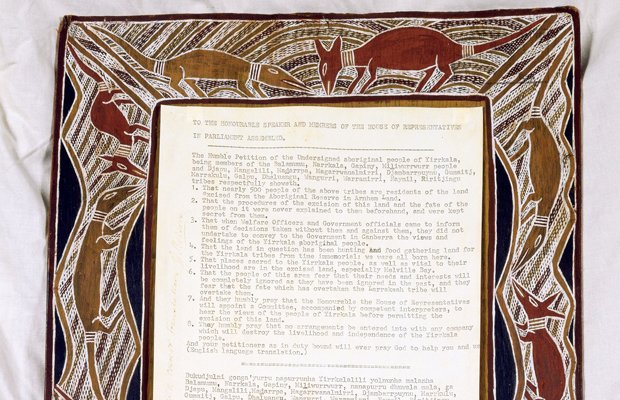
Yirrkala Bark Petitions
In August 1963 two bark petitions were presented to the Australian Parliament’s House of Representatives. This was a formal attempt by the Yolngu of arnhem Land to have their land rights recognised. It was also the first time documents incorporating First Nations ways of representing relationships to land were recognised by parliament.
1965
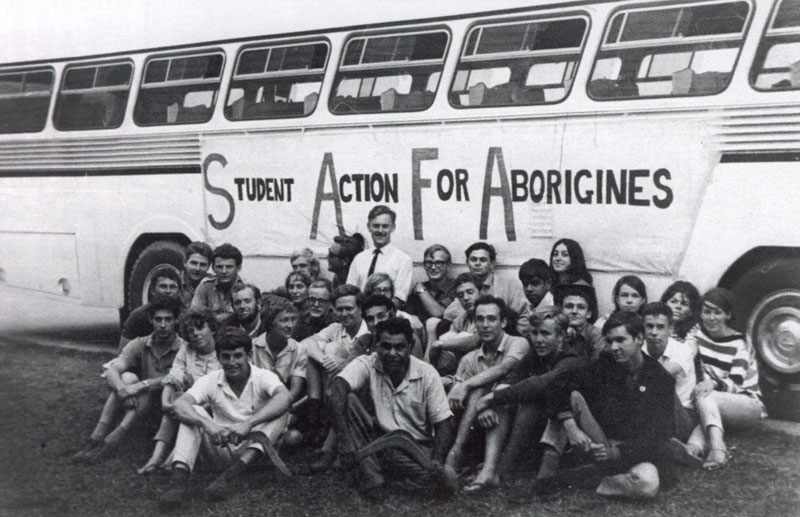
1965 Freedom Ride
A group of students from the University of Sydney drew national and international attention to the appalling living conditions of Aboriginal people and the racism that was rife in New South Wales country towns. The 15-day bus journey through regional New South Wales would become a defining moment in Australian activism. In addition to generating local discussion, they directly challenged a ban against Aboriginal ex-servicemen at the Walgett Returned Services League, and local laws barring Aboriginal children from the Moree and Kempsey swimming pools.
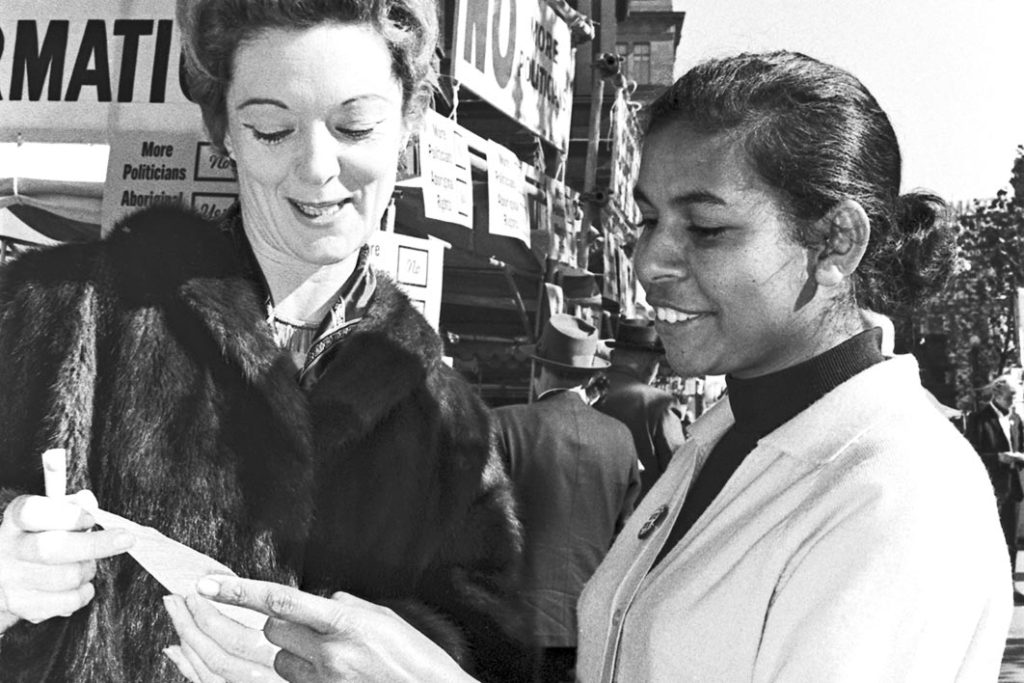
Australians voted to change the Constitution so that like all other Australians, Aboriginal and Torres Strait Islander peoples would be counted as part of the population and the Commonwealth would be able to make laws for them. A resounding 90.77 per cent said ‘Yes’ and every single state and territory had a majority result for the ‘Yes’ vote. It was one of the most successful national campaigns in Australia’s history.
9 July 1971
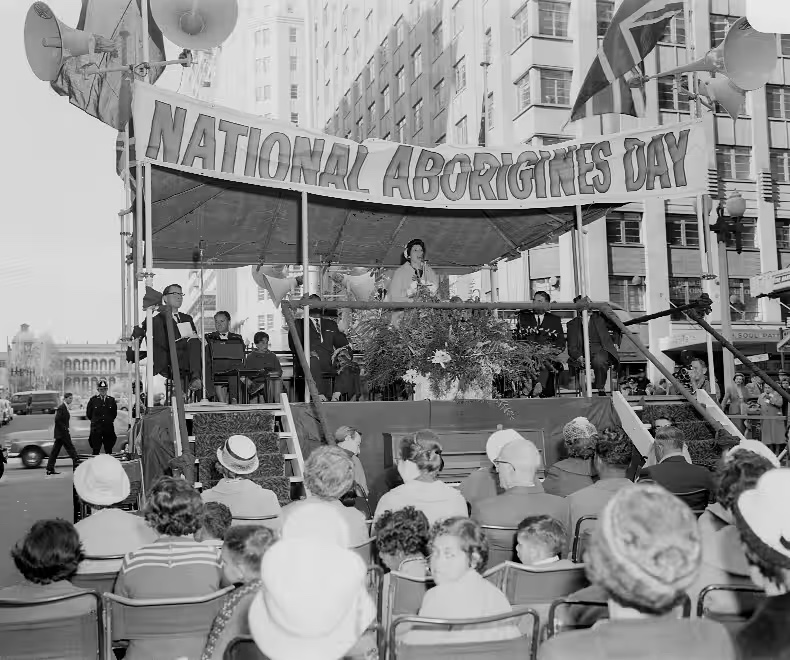
The Aboriginal flag
The Australian Aboriginal Flag is raised for the first time, at a land rights rally in Victoria Square/Tarntanyangga, Adelaide, on then National Aborigines Day.
It was designed in 1970 by artist Harold Thomas, a Luritja man from central Australia and a member of the Stolen Generations.
16 Feb 1983
Ash Wednesday Southern Victoria bushfires. 47 killed, 210,000 ha burned.
5 March 1983
Reconciliation meaningfully enters the language of politics for the first time with Bob Hawke winning a landslide election on a platform that included the need for national reconciliation with first Australians, with self-determination, land rights, and addressing of “the worst conditions – the health, housing, employment, education, and the greatest poverty and despair. While this situation persists, we can never truly bring this country together.”
1985
The Wurundjeri Council is established by blood line descendants of the Wurundjeri people.
1988
Bicentennary of white Australia
1991
Royal Commission into Aboriginal Deaths in Custody report published
2 September 1991
Council for Aboriginal Reconciliation is formed
The Australian Parliament passes an Act creating the Council for Aboriginal Reconciliation, and marking the official movement toward national reconciliation. The central purpose of the Council is to guide the reconciliation process over the rest of the decade, leading up to the anniversary of Federation in 2001. It aimed to do this through increased understanding of Indigenous cultures, the history of past dispossession and present-day disadvantage, and to foster a national commitment to addressing these disadvantages.
3 June 1991
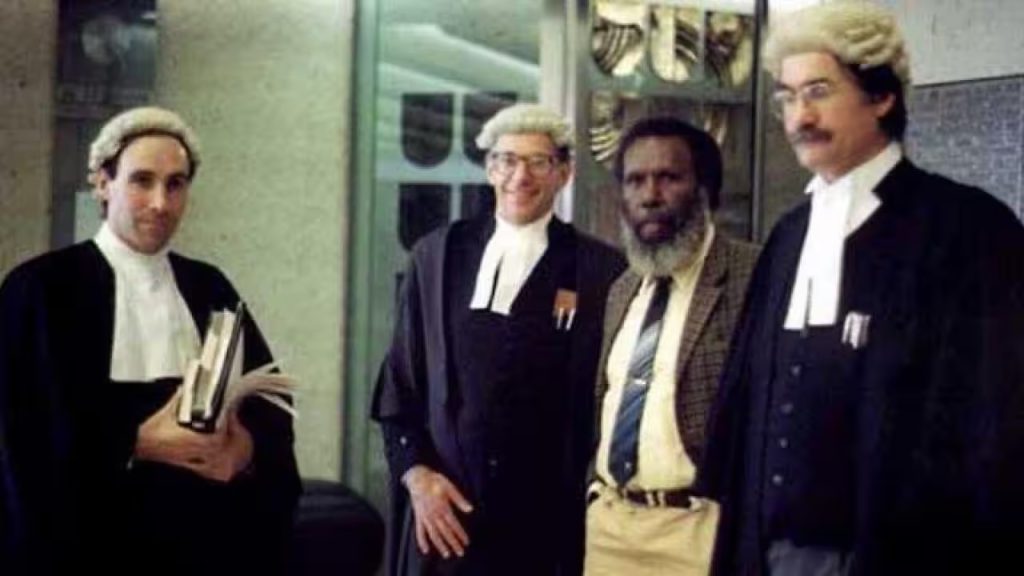
The Mabo Decision
The High Court of Australia overruled Cooper v Stuart, rejecting the doctrine of terra nullius and stating that Australian law could recognise native title. However, the Court also placed strict limits on native title, and held that Australian law can validly extinguish First Nations peoples land rights.
27 May 1993
Origin of National Reconciliation Week
As part of the International Year of the World’s Indigenous Peoples, Australia’s major faith communities together support a “Week of Prayer for Reconciliation”, which from 1996 (with the support of the Council for Aboriginal Reconciliation) becomes National Reconciliation Week.
The dates for NRW remain the same each year, commemorating two significant milestones; the the successful referendum on 27 May 1967, and the High Court Mabo decision on 3 June 1991.
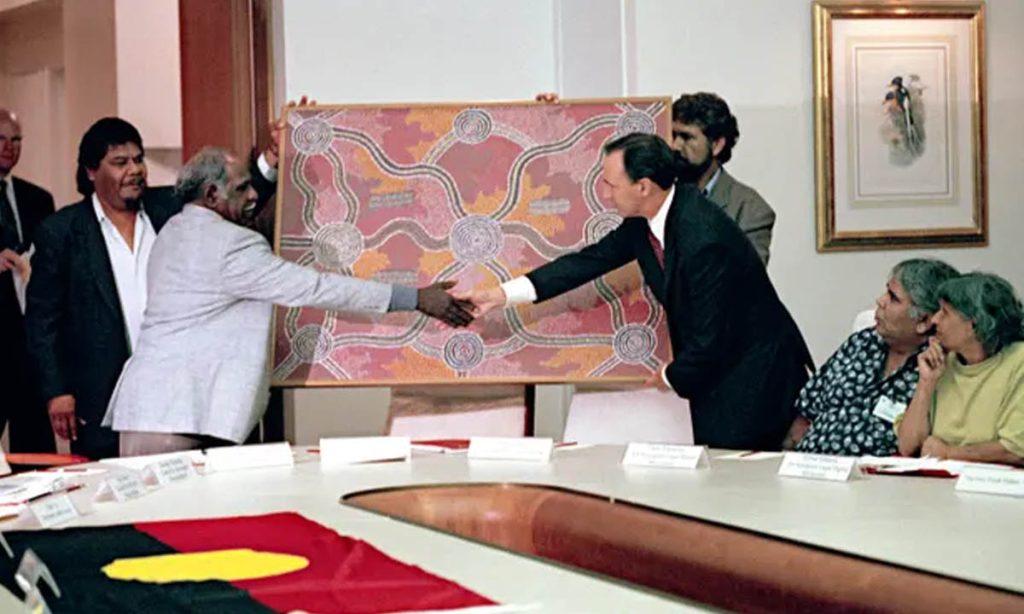
1993
Native Title Act 1993
Prime Minister Paul Keating believed that legislation was the best way ‘to do justice to the Mabo decision in protecting native title and to ensure workable, certain, land management’. After several months of difficult negotiation, the Commonwealth Parliament passed the Native Title Act 1993 (Cth).
14 July 1995
In view of the flag’s wide acceptance and importance in Australian society, the Australian Aboriginal Flag (designed in 1970 by artist and a Luritja man Harold Thomas, and first raised on 9 July in 1971 at a land rights rally in Adelaide) and the Torres Strait Islander Flag are proclaimed by Governor General of Australia William Hayden as flags of Australia under section 5 of the Flags Act 1953
1990s
200 acres including Coranderrk’s only surviving building – the superintendent’s residence – was purchased by the Indigenous Lands and Sea Corporation (ILSC). The property is now managed by Wandoon Estate Aboriginal Corporation (WEAC).
16 Dec 1994
Shire boundaries changed
Shire of Diamond Valley abolished, areas south of Ring Rd transferred to new City of Banyule. Areas north are merged with Shire of Eltham and parts of City of Whittlesea into the new Shire of Nillumbik.
1995
The Australian Government asks the Human Rights and Equal Opportunity Commission to carry out a National Inquiry into the Separation of Aboriginal and Torres Strait Islander Children from Their Families, The Inquiry was established because of the efforts of many Indigenous communities concerned that the public’s ignorance of forcible removal was hindering the recovery of Stolen Generations members and their families.
23 December 1996
Wik decision
In a case, initiated before the Native Title Act, between the Wik peoples of western Cape York peninsula and pastoral and mining leaseholders in the area, a decision of the High Court of Australia finds that pastoral leases did not bestow rights of exclusive possession on the leaseholder. As a result, native title rights could coexist depending on the terms and nature of the particular pastoral lease. Where there was a conflict of rights, the rights under the pastoral lease would extinguish the remaining native title rights. However, it is commonly accepted to include rights to perform ceremonies or to gather foods or medicines.
The reactions provoked by the decision were intense and deeply divisive, led by conservative politicians, agricultural and mining interests. The consequent amendments to the Native Title Act in 1998 were a devastating blow to Indigenous peoples’ rights.
26 May 1997
Australian Reconciliation Convention
More than 1800 people attend the two-day Australian Reconciliation Convention in Melbourne, organised by the Council for Aboriginal Reconciliation. Attendees had participated in meetings across the country in the year prior to the Convention. Events were overshadowed by the opening address made by then Prime Minister, the Hon. John Howard MP:
In facing the realities of the past, […] we must not join those who would portray Australia’s history since 1788 as little more than a disgraceful record of imperialism […] such an approach will be repudiated by the overwhelming majority of Australians who are proud of what this country has achieved although inevitably acknowledging the blemishes in its past history.
Despite Howard’s comments, the Convention succeeded in bringing the issue of reconciliation into the national consciousness.
26 May 1997
Bringing Them Home report
The landmark ‘Bringing Them Home’ report is tabled in Federal Parliament. The report was the result of a national inquiry that heard from around 1000 Aboriginal and Torres Strait Islander people. It investigated the forced removal of 1 in 10, possibly as many as 1 in 3, Indigenous children from their families between 1910 and the 1970s. This report marked a pivotal moment in the healing journey of many Stolen Generations members. It was the first time their stories—stories of being taken from their families—were acknowledged in such a way.
1 May 1997
Citizen’s Statement & ANTaR
The Citizens’ Statement was a petition authored by ANTaR aimed at mobilising non-Indigenous support for native title and reconciliation. The statement was launched on 1 May 1997 in response to the Howard Government’s Ten Point Plan strategy for amending the Native Title Act 1993.
September 1997
Howard’s ‘Ten Point Plan’
In a legislative response to the previous year’s Wik decision, the Native Title Amendment Bill is introduced in Parliament by the Howard government. Known as the ‘Ten Point Plan’, the Bill proposed to broaden the power of governments to extinguish native title, remove the right to claim over urban areas and make the initiation of claims more burdensome.
The amendments were passed in 1998, adding 400 pages of law, and drastically increasing the complexity of the Native Title Act, changing the system markedly.
12 October 1997
Sea of Hands
Australia awakes to the biggest art petition the nation had ever seen. Assembled on the lawns of Parliament House, Canberra were 70,000 plastic hands bearing the names of individual Australians that had signed the Citizens’ Statement on Native Title.
In the decades since, Sea of Hands installations have become a wider symbol of the people’s movement for reconciliation.
Local reconciliation groups start forming, including an advisory committee delegated by Nillumbik Shire Council to arrange a ceremony promoting reconciliation.
March 1998
Part of the Coranderrk Aboriginal Station is returned to the ownership of the Wurundjeri Council.
9 May 1998
Nillumbik Reconciliation Walk & Ceremony
A formal document of Acknowledgement, Apology and Commitment is presented by Nillumbik Shire Council to Wurundjeri elders at a ceremony in May 1998 at Wingrove Park, Eltham.
1999
Motion of Reconciliation in parliament falls short of apology
24 September 2000
Cathy Freeman’s Victory
During her 2000 Olympic Games victory lap after the 400 metre sprint, Cathy Freeman carried both the Australian and Aboriginal flags — a symbol of reconciliation and pride in her Aboriginal cultural heritage. She was the first Australian Aboriginal person to win an individual Olympic gold medal.
2000
NRG incorporated
2000
Corroboree 2000
2000
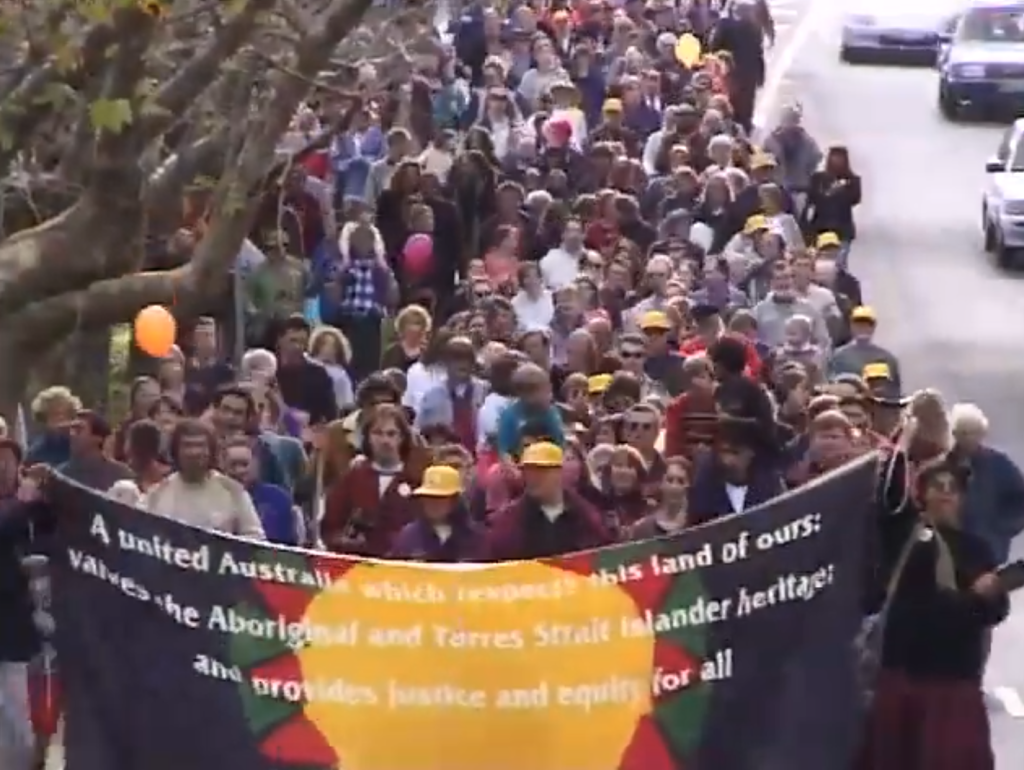
Walk for Reconciliation
The Bridge Walk for Reconciliation and similar events that took place around Australia in the weeks following were collectively the biggest demonstration of public support for a cause that has ever taken place in Australia. The march was a public expression of support for meaningful reconciliation between Australia’s Indigenous and non-Indigenous peoples.
2001
CAR stops. Rec Aus starts
21 June 2007
The Intervention
The Federal Government announces far-reaching policies affecting Aboriginal communities in the Northern Territory. Using a report documenting child sexual abuse in these communities as justification, it launched the Northern Territory Emergency Response, also known as the intervention.
While some policies offered improvements to health, housing and measures to reduce violence, many policies did not relate to the stated goals and offered benefits that could have been provided without breaching human rights.
Described by Aboriginal leader Pat Dodson as “a regime of coercive paternalism,” one of its major criticisms is that the government did not properly consult with Aboriginal people. It reminds Indigenous people of politics of the mission days when non-Aboriginal managers had dictatorial powers over almost every aspect of their lives.
A plaque commemorating the Battle of Yering is unveiled at Yarra Flats Billabong near Yarra Glen by Wurundjeri Ngurungaeta, Murrundindi.
13 February 2008
Apology to Australia’s Indigenous Peoples
Prime Minister Kevin Rudd offered a formal apology to Australia’s Indigenous peoples, presented as a motion for voting to the Chamber. It acknowledged that ‘the laws and policies of successive Parliaments and governments had resulted in the forcible removal of Aboriginal and Torres Strait Islander children from their families and ‘inflicted profound grief, suffering and loss on these our fellow Australians’.
2008
Closing the Gap govt strategy starts
2008
Nillumbik Shire Council passes a Reconciliation Charter
17 April 2008
Moor-rul Platform & Grasslands open
The Moor-rul Viewing Platform and the adjacent Moor-rul Reconciliation Grasslands are officially opened at Kangaroo Ground Memorial Park.
22 August 2008
Wurundjeri Woi Wurrung Cultural Heritage Aboriginal Corporation becomes a Registered Aboriginal Party.
Source: Victorian Aboriginal Heritage Council
7 Feb 2009
Black Saturday bushfires. 173 people killed. 411,239 ha burned.
2009
Australia recognises UN Declaration on Rights of Indigenous Peoples
2010
National Congress of First Peoples established (until 2019)
2012
The titles Wil-im-ee Mooring (Mount William) and the nearby Sunbury Rings Complex are returned to Wurundjeri people.
2012
Members of the Wurundjeri Council gathered greenstone blanks from the Wil-im-ee Moor-ring (Mount William) quarry to make axes with which to scar a River Red Gum at Plenty Gorge to build a koorong (canoe).
2012
Campaign for constitutional recognition begins
2013
Aboriginal and Torres Strait Islander Peoples Recognition Act 2013
6 October 2013
A ceremony is held at which Wurundjeri Elder Uncle Bill Nicholson named the Heide tree ‘Yingabeal’ – River Red Gum Songline Marker Tree (Yinga meaning sing, and Beal meaning River Red Gum).
The ‘Yingabeal’ scar-tree is said to mark the point where five different Songline routes meet and come together. Physical markers like ‘Yingabeal’ allowed the traveller to know where they were in their journey.
August 2015
The Wurundjeri Council launched a ceremonial ground in Warrandyte, near Garrambi Baan (Laughing Waters). Three trees were scarred to commemorate this event in recognition of the family groups that comprise Wurundjeri.
2015
Referendum council established
2016
SA, Vic and NT announce beginning of discussions on Treaty
May 2016
William Barak’s cultural work Ceremony goes up for auction in Sydney. An approach to the owner by the Wurundjeri Council about the future of the work is rejected, and a crowdfunding campaign to repatriate it falls short of the funds needed.
February 2017
Yarra River Action Plan
Elders of the Wurundjeri Council, Premier Daniel Andrews and ministers of the Victorian government unveil the Yarra River Action Plan Wilip-gin Birrarung murronor (keep the Birrarung alive).
26 May 2017
Uluru Statement
The Uluru Statement from the Heart is a petition to the people of Australia, written and endorsed by the Australian Aboriginal and Torres Strait Islander leaders selected as delegates to the First Nations National Constitutional Convention. The document calls for substantive constitutional change and structural reform through the creation of two new institutions; a constitutionally protected First Nations Voice and a Makarrata Commission, to oversee agreement making and truth-telling between governments and First Nations.
22 June 2017
Elders of Wurundjeri Council address Victorian Parliament
Wurundjeri Elder’s address the Victorian parliament in an unprecedented ceremony to support the Wilip-gin Birrarung murron (Yarra River Proctection) bill 2017. The legislation creates an independent body called the Birrarung Council and grants Wurundjeri people a legislatively-enshrined voice in the formal custodianship of the Birrarung.
22 June 2018
The Victorian Parliament passes legislation to create a framework for negotiating a treaty with Aboriginal people. The legislation is supported by the Labor Government and the Greens, but not by the opposition Liberal and National parties. The legislation includes provisions to create an Aboriginal representative body.
16 September 2024
The 2019 Victorian First Peoples’ Assembly election is held to elect 21 members to the First Peoples’ Assembly in Victoria, which is charged with the responsibility of preparing for negotiations with the Victorian Government about a treaty with the state’s Aboriginal population.
26 October 2019
Uluru Climb Closed
On the 34th anniversary of the Handback, the climb of the sacred Uluru was permanently closed to tourists. This closure was the result of a unanimous decision made by the Uluru-Kata Tjuta National Park Board of Management in November 2017, which was implemented after visitor numbers climbing Uluru fell below 20%, meeting the established criteria for closure.
10 December 2019
First Peoples’ Assembly of Victoria meets for the first time, in the chamber of the upper house of the Victorian Parliament.
2020
The decentralised political and social Black Lives Matter movement gains international attention during global protests following the murder of George Floyd by a Minneapolis police officer.
24 May 2020
Destruction of Juukan Gorge
Despite warnings, Rio Tinto detonates a blast at the Brockman 4 iron ore mine in the Pilbara region of Western Australia.
The blast destroys known sites at rock shelters in Juukan Gorge of great cultural and archaeological significance, including evidence of continuous human occupation for over 46,000 years by the Puutu Kunti Kurrama and Pinikura peoples.
The distressing act that sparks outrage across the globe and triggers an Australian parliamentary inquiry into the disaster that recommends greater heritage protections in Australia.
January 2022
Aboriginal Flag copyright
The Commonwealth of Australia acquires the copyright of the Aboriginal Flag and, despite appointing an exclusive licenced manufacturer and provider of Aboriginal flags and pennants, allows the design of the Australian Aboriginal Flag to be freely reproduced by the public on all other mediums.
2023
The Nillumbik Shire Council begins developing its first ‘Reflect’ Reconciliation Action Plan (RAP), to replace the Reconciliation Charter committed to in 2008.
Over 300 people attend an event to celebrate reconciliation in Nillumbik, showcasing past achievements and ongoing efforts, and marking 25 years since Uncle Bill Nicholson Senior accepted a Document of Commitment from the Nillumbik Shire Council 1998.
14 October 2023
Voice referendum fails
A referendum to recognise First Peoples in the Australian constitution with an Indigenous advisory body, the ‘Voice to Parliament’, fails after more than 60% of Australians voted “No”.
Australian Indigenous leaders call for a week of silence and reflection.
The outcome is a major setback for reconciliation efforts with the country’s First Nations communities and damages Australia’s image in the world regarding how it treats First Nations people.
17 July 2024
Ready for treaty
The First Peoples’ Assembly of Victoria officially notifies the Treaty Authority that they are ready to negotiate a Statewide Treaty with the Victorian Government.
TODAY
What will you do, personally, to help create reconciliation in Australia?